
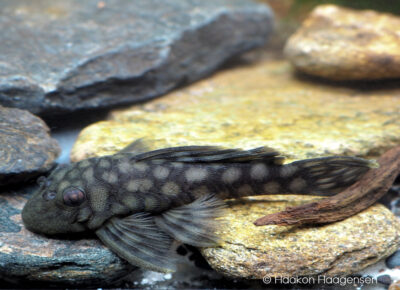
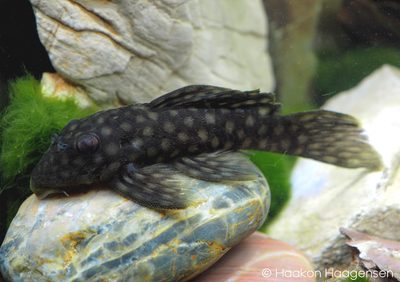
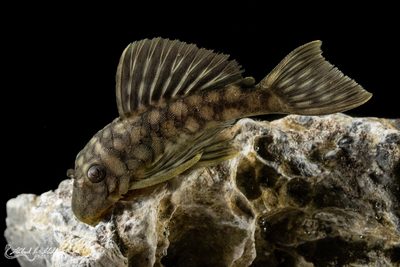
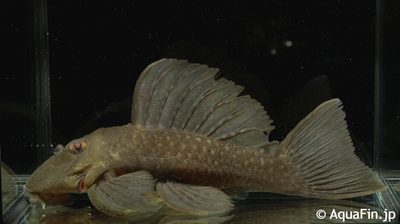
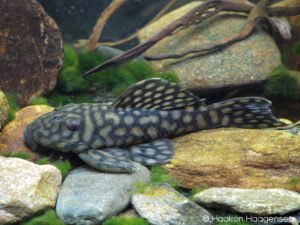
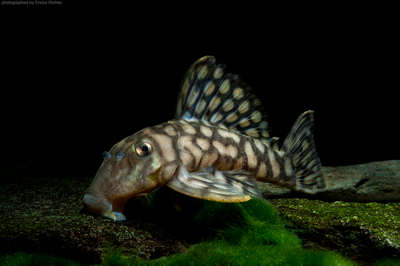
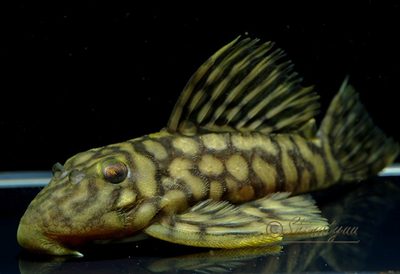
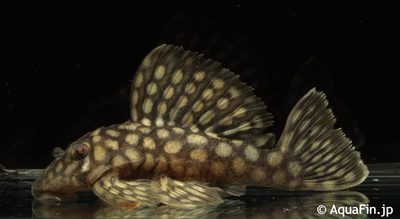
Spectracanthicus zuanoni is a somewhat overlooked species, which is a bit hard to understand. Maybe it doesn’t show off the same striking pattern as Hypancistrus or Peckoltia species, but it’s still a great looking fish! Also, they don’t grow very large, and when well conditioned they are quite easy to maintain. S.zuanoni originates from Rio Xingu, Brazil, and like every other aquatic lifeform there the damming of the river impacts it’s existence. Captive breedings are rare so the future of this species is very uncertain, but for now there is a steady supply of wild caught specimens coming in. The form L20 is found in the Rio Xingu around Altamira, and the form L354 is mainly found in the Rio Iriri but also in the Rio Xingu itself.
Facts:
Name: Spectracanthicus zuanoni (Chamon & Rapp Py-Daniel, 2014)
Trade names: L20, L354, Acari Bola Branca
Origin: Rio Xingu, Brazil
Maximum size: 15 cm / 6”
These medium sized plecos are found in rock crevices in the rapids of Rio Xingu and its affluent Rio Iriri. They need an aquarium set up consisting of lots of hiding places in the form of rocks, wood and of course specially made caves that suit their measurements. In these the males will eventually guard their offspring. They prefer water that is fairly warm (27-30 C), soft and slightly acidic. Most of all it should be well oxygenated and clean, so a good filtration system and frequent water changes are essential. It’s a slightly timid and withdrawn species that doesn’t really compete too well for food and territories, so it shouldn’t be placed in a tank with much competition for resources. Among themselves they are fairly peaceful, although males may quarrel for caves and territories. Spectracanthicus species are omnivore, and should be fed a varied diet. They seem to prefer high quality dry foods, crustaceans and insect larvae.
The form we call L20 varies in its pattern. Some individuals show larger dots and less spotting on the head, others have more numerous, smaller dots. The form L354, which is collected from Rio Iriri, grows larger, has a higher, more compact body and larger, lighter spots than L20. It’s basically a more beautiful form with a higher price tag, and is traded much less frequently than L20. Some argue they are two different species, but as the years have passed we have come to realize that the Loricariidae species of the Xingu-system often vary in their appearance, probably to adapt to certain niches in the river. This makes them look different to our eyes, but genetically they are not different on a species level. This is apparently also the case with L20 and L354, and the topic is even discussed in the scientific description of S.zuanoni from 2014. In the two rows of images above, the L20 form can be seen in the top row and L354 in the lower row.
For years we called this fish Oligancistrus, not Spectracanthicus. However, Oligancistrus is now considered a junior synonym to Spectracanthicus: In 2004, researcher Jonathan W. Armbruster proposed the synonymy. He argued that there was an absence of distinct diagnostic features to differentiate the type species of the two genera (Oligancistrus punctatissimus and Spectracanthicus murinus). Both genera share primary defining traits within the Ancistrini tribe, most notably a distinct dorsal-fin membrane that expands backwards to connect with the adipose-fin spine. Because they lacked exclusive unique traits separating them, maintaining two closely related, mostly monotypic genera was deemed unnecessary.
Paraphyletic Nature (Chamon, 2012); A major phylogenetic study by Carine C. Chamon in 2012 further solidified this classification. Her evolutionary analysis of the Acanthicus group revealed that Oligancistrus was paraphyletic. This means that the species assigned to Oligancistrus did not form their own distinct, isolated evolutionary branch; instead, they represented successive “sister-groups” directly leading to Spectracanthicus murinus. In modern taxonomy, organisms cannot be lumped into a genus that doesn’t form a clean, exclusive evolutionary group (a monophyletic clade), validating the decision to dissolve Oligancistrus into Spectracanthicus.
More info: